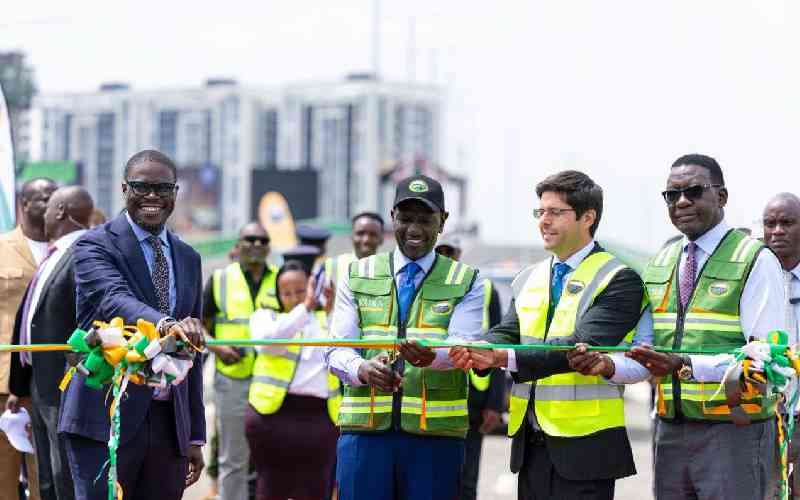
President William Ruto officially opens the 820-metre Ngong Road-Naivasha Road Flyover. [PCS]
The review of a long-term national development blueprint such as Vision 2030 is a routine, yet profoundly important exercise for any administration. President William Ruto and the Kenya Kwanza Government find themselves at the centre of this historic milestone simply because they are in office at a time when Vision 2030 is approaching its conclusion.
Planning for a post-Vision 2030 blueprint has little to do with the current administration and everything to do with the people of Kenya. Like Vision 2030 before it, the next long-term development agenda should emerge from a highly participatory, consultative and inclusive process involving international and local experts, ordinary Kenyans, and stakeholders from every part of the country.
The President's call for a national conversation on a post-Vision 2030 blueprint is, in principle, a welcome initiative. On the face of it, one would wonder why opposition leaders would oppose such a process and why many Kenyans have shown little enthusiasm for it.
Part of the answer lies in the prevailing political environment.
In recent weeks, the President has come under sustained political pressure from the opposition. This has been compounded by the UDA Party's loss in the Ol Kalou by-election, a result that has sparked anxiety within the ruling party.
The aftermath of the by-election saw what many perceived as attempts to shift public attention, including UDA Secretary-General's attacks on former President Uhuru Kenyatta and the Kikuyu community, as well as Health Cabinet Secretary Aden Duale's inflammatory remarks targeting Kikuyus. Although the President publicly downplayed the significance of the loss, the prevailing mood across the country suggests that financial muscle alone may no longer be the decisive factor in the 2027 General Election.