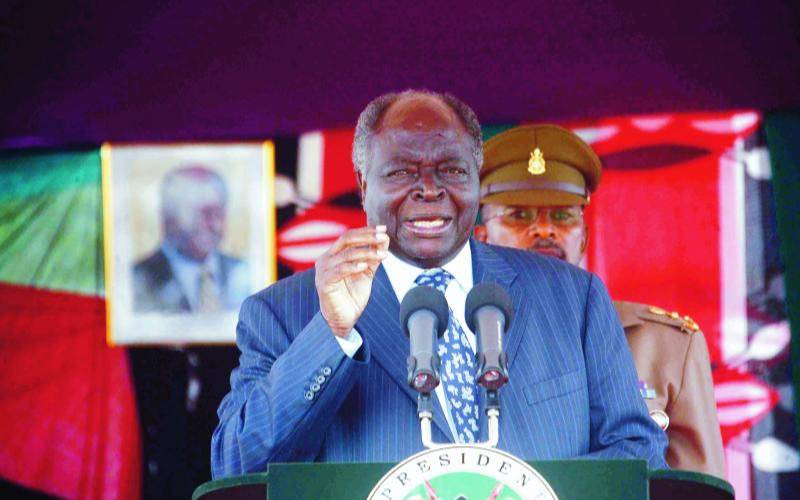
Former President Mwai Kibaki launched Vision 2030 to transform Kenya into a middle-income economy. [File, Standard]
As the debate to chart a new development blueprint beyond Vision 2030 gathers pace, the country’s flagship economic plan is facing renewed scrutiny after falling well short of its central promise of delivering sustained double-digit economic growth.
An analysis of the blueprint’s key economic indicators shows that nearly two decades after its launch, Kenya has never achieved the targeted 10 per cent annual growth rate that was expected to transform it into a globally competitive, middle-income economy by 2030.
Instead, sluggish expansion in the agriculture and manufacturing sectors—the two pillars expected to drive that transformation—has consistently held back the economy.
The vision set the target of banking the gross domestic product (GDP) expansion on agriculture and manufacturing sectors.
However, the highest the country has achieved since then is 7.6 per cent in 2021, largely because the previous year, during the height of Covid-19 lockdowns, Kenya reported a negative deviation of 0.3 per cent.
The Vision 2030 document primes agriculture as the key sector to propel the economy to a 10 per cent growth rate, and consequently supporting the social development agenda such as job creation, foreign exchange and attracting investments.
“To meet the goals, the sector has to become more efficiency-driven, raising productivity per unit of input (especially of labour and capital) closer to those of Kenya’s external competitors,” the document states.