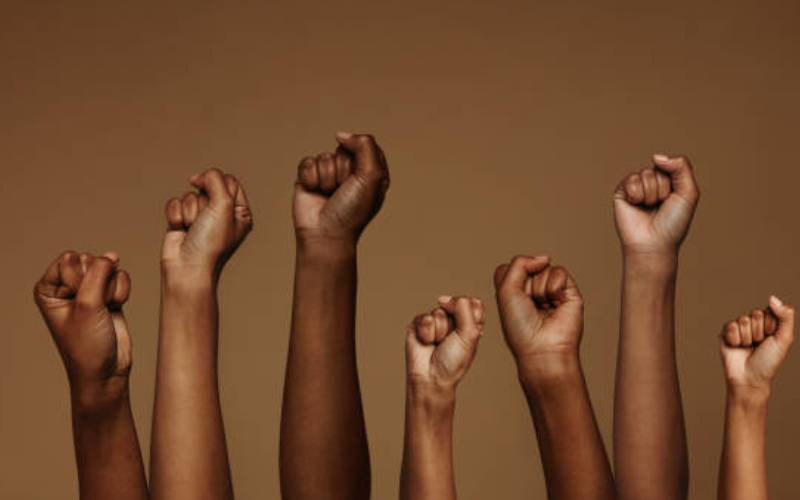
Raised fists in a show of support for democracy and civil liberties. [iStockphoto]
As news about Ol Kalou recedes from the headlines, the violence witnessed during the by-election is still raising concerns about the sorry state of democracy in Kenya. For many citizens, the rise of the goon culture and pervasive violation of civil liberties is raising fears that the country is reverting to the intolerance witnessed during the single-party era.
Incidences of violation of civil liberties characterised by widespread violence, voter bribery and intimidation were beamed into living rooms on prime-time television to the chagrin of many. On social media, trending videos of goons in black SUVs firing in the air to scare away voters as frightened voices of cowering citizens were heard from their hideouts. Watching the chaos, one could be forgiven for mistaking the by-elections in Ol Kalou with a scene out of Haiti.
For a country that flattered itself as the pre-eminent democracy in East Africa, the widespread violence has been quite sobering. Just like presidential elections in Uganda and Tanzania, the violence witnessed during by-elections in Malaba, Mbeere and Ol Kalou has destroyed all illusions of Kenya’s exceptionalism.
The violent scenes witnessed in the by-elections were, however, not any different from those witnessed in recent presidential elections in Tanzania and Uganda. Weeks before elections in Tanzania, members of the Opposition were jailed and civil rights observers from Kenya and Uganda were deported and others tortured. Notwithstanding widespread protests over election results, President Samia Suluhu declared herself duly elected with a margin of 98 per cent of the votes cast. Suluhu again hit the headlines after she invited President William Ruto to join her in suppressing human rights groups operating in the two countries.
Using a similar playbook, the President of Uganda was re-elected to serve an eighth term in office. As a strongman who fancies himself as the African equivalent of Fidel Castro, dissenting voices in Uganda have suffered all manner of persecution that include imprisonment, renditions and sham trials. The latest violation of civil liberties included shutting down the mainstream media for printing unflattering comments about the strongman. The regime’s intolerance for free speech was illustrated by a chilling warning that the media must follow rules of the revolution.
Despite widespread abuse of human rights, the three East African countries describe themselves as constitutional democracies. Kenya’s 2010 constitution, for instance, has been lauded as one of the most progressive in the world because of its robust Bill of Rights. Notwithstanding such glowing accolades, young Kenyans continue to be disappeared, and opposition meetings are routinely disrupted by goons.
Considering the widespread violation of civil liberties, a pertinent question is how such egregious unconstitutionality can exist in countries with liberal constitutions. Why is liberal democracy failing to take root in East Africa despite sterling efforts by local and international human rights groups?