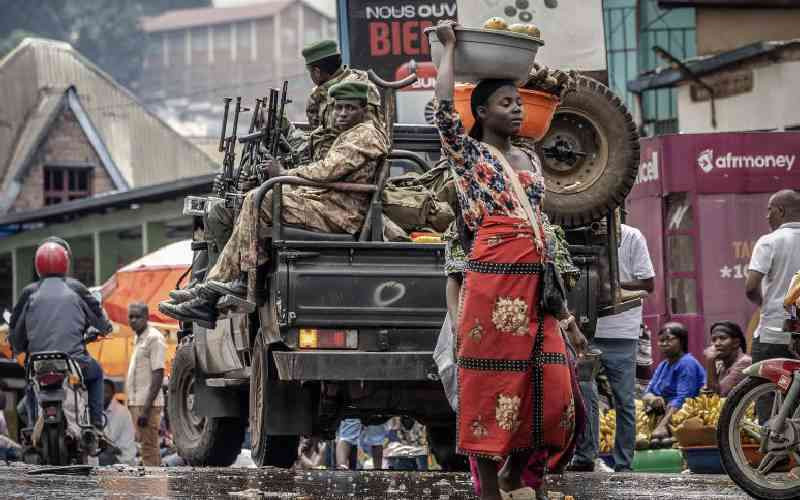
Members of the M23 armed group sit on a pickup truck during a patrol as women carrying fruits walk past a market, following the takeover of the city by the M23 movement in Bukavu on February 18, 2025. [AFP]
For decades, the conflict in eastern Democratic Republic of the Congo (DRC) has been explained through a narrow lens that emphasises mineral resources, foreign interference, and military confrontation while overlooking people's rights and the political failures that have repeatedly driven communities back to war.
That emphasis has led to botched remedies, with peace remaining elusive for over three decades. If Africa is to find a solution to one of the continent's longest-running conflicts, it must confront its underlying causes. In other words, it must move beyond simplistic narratives and rewrite that story.
The M23 maintains that it resumed armed struggle after the Congolese government failed to implement the March 23, 2009 Peace Agreement. The peace deal contained commitments on the protection of Congolese Tutsi communities, citizenship and identity rights, the return of refugees, and the integration of former combatants.
Whether one accepts the AFC/M23's justification or not, it is difficult to ignore that many of these issues remain unresolved more than fifteen years later. The persistence of these grievances suggests that the conflict is fundamentally political rather than resource-driven, as is often suggested.
The conflict is not about territory either, or simply restoring state control. Since re-emerging, the AFC/M23 has taken control of significant parts of North Kivu and South Kivu provinces. Kinshasa, backed by several international partners, has consistently insisted that the rebels withdraw from the territories they administer. Yet the more fundamental question remains unanswered: would such withdrawals, by themselves, produce security and, eventually, lasting peace for the people of eastern DRC?
The AFC/M23 has consistently argued that its objective is not the conquest of territory, but to compel meaningful political negotiations. On several occasions, the movement has withdrawn from areas under its control, describing these decisions as confidence-building measures intended to create space for dialogue.
However, these withdrawals have often been followed by renewed violence against civilians, particularly Congolese Tutsi and Banyamulenge communities who are frequently accused of sympathising with the rebels.