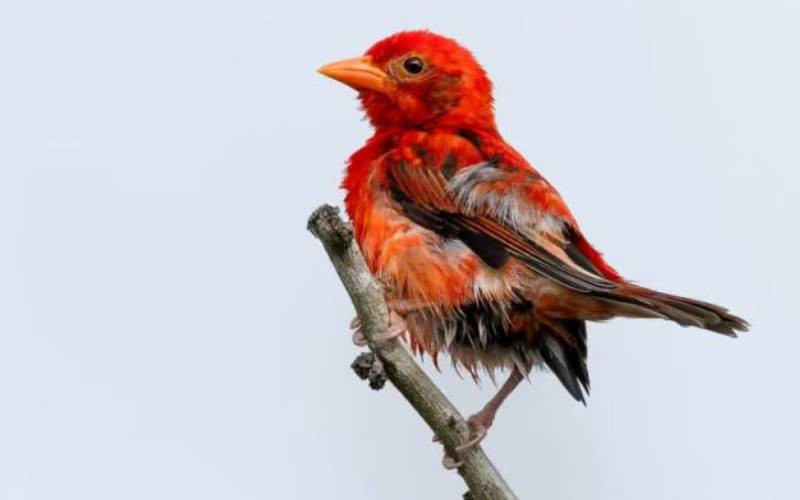
Kenya's Red Weaver in the Boni-Dodori Forest on July 3, 2026 .[Courtesy]
When James Apolloh Omenya and Simon Odhiambo walked alongside a team of local guides and armed Kenya Defence Forces (KDF) escorts into the dense Boni-Dodori Forest, it seemed, on the surface, like just another gruelling day in the field.
Yet deep down, they knew the Red Weaver, a bird last photographed 12 years ago, existed somewhere in the thickets. It was this belief that drove them to comb through remote, security-sensitive terrain purely to contribute to science.
The last time the bird had been documented on camera was in April 2014, when ornithologist John Musina took a photograph of a male in the Boni-Dodori Forest. As the years passed without another record, scientists grew increasingly worried. In March 2025, having gone over a decade without a confirmed sighting, the Red Weaver was officially added to the global Search for Lost Birds priority list.
Although the International Union for Conservation of Nature (IUCN) Red List had long classified the Red Weaver as "Least Concern," experts knew this was a dangerous illusion because its population size was entirely unknown due to an extreme lack of field records.
“Spotting the Red Weaver has been extraordinarily difficult because its primary home, the Boni-Dodori Forest near the Kenya-Somalia border, is a high-risk area where security concerns severely restrict field research,” said Musina, a researcher with the National Museums of Kenya.
Until the team's breakthrough on July 3, 2026, Kenya had two bird species listed on the global Search for Lost Birds registry. With the Red Weaver now found, only the Tana River Cisticola remains actively listed as “Lost.” It has not been officially documented for 59 years, since 1967, and is currently the target of joint field expeditions by Nature Kenya, the National Museums of Kenya, and A Rocha Kenya.
Part of the Red Weaver’s disappearance was also a matter of classification. For over a century, the bird was grouped as a subspecies of the common Red-headed Weaver. Because it was not recognised as a stand-alone species, birdwatchers and researchers rarely tracked it.