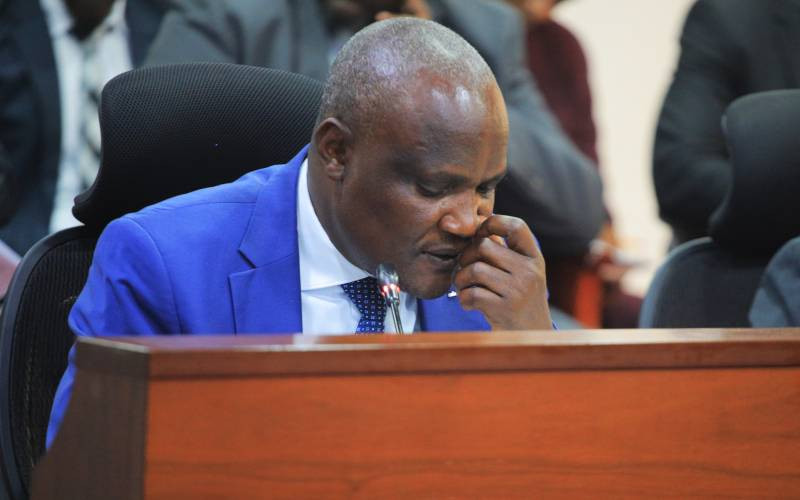
CS Treasury John Mbadi grilled by members over the legibility of public participation used regarding the importation of condemned raw sugar by MSRL when he appeared before the National Assembly's Trade Committee Chaired by Ikolomani MP Bernard Masaka Shinali at Bunge Towers, Parliament, Nairobi. July 21st,2026 [Elvis Ogina, Standard]
We are often told that politicians are temporary, but government is permanent. Yet we live in a country of almost permanent political campaigns, including current events leading into 2027. In the resulting cacophony, it has been easy to miss the first public milestone in the 2027/28 budget season, publication of the 2026 Budget Review and Outlook Paper (BROP) on August 11th.
Kenyans were invited to offer comments on this document within a short eight-day period, by August 19th. Welcome to our “Treasury as usual” mindset, completely ignoring the established practice of 14 days for public participation which is now set out in law, and which should have ended today.
According to the budget calendar, BROP is expected to go to Cabinet tomorrow (August 26th), to be approved by August 30th and submitted to Parliament by September 1st.
Surprisingly, unlike the Budget Policy Statement (BPS) or Budget Estimates, Parliament does nothing with, or to, BROP in debate or amendment, it is a passive recipient like the rest of us.
Before we delve into its detail, the 2026 BROP reminds us that we have an accelerated budget calendar for 2027/28, owing to the 2027 election. Public hearings to discuss sector budget proposals will be held from October 12th to 14th, the draft BPS should be ready by October 30th, draft Budget Estimates for 2027/28 should be available from next January 20th, with the draft 2027 Finance Bill available a week later, the Budget Statement will be read on March 18th, and hopefully, both the Appropriations and Finance bills will be passed by Parliament by March 31st, three months earlier than usual. Yes, government is perpetual, but we still need to close shop for elections. I have never been convinced by this lazy rationale, especially since, technically, early approval does not mandate early spending, the 2027/28 financial year will still begin on July 1st, not April 1st.
The other way to look at this early approval is it locks in the 2027/28 fiscal framework for the incoming administration, even if it’s the current one. So, in the four months and a bit before we actually vote, we have a chance to interrogate electoral competitors not just on promises in their rosy manifestos but on their realism in the face of 2027/28 budget, and wider economic, realities. For the Kenya Kwanza incumbents, it is also a chance to reflect on their fiscal management record since they assumed office, away from political rallies, social events and sunroof announcements.
Let’s take a step back. What is BROP? In simple terms, it is a three part document; the first part offers a previous year (2025/26) review of the fiscus; the second presents a review and outlook on the macro-economy, and the third teases out a next year (2027/28) fiscal projection. As is recent practice, the draft describes a resource allocation framework in the third part, including ten criteria for resource prioritization within sectors without specifying sectoral budget ceilings.