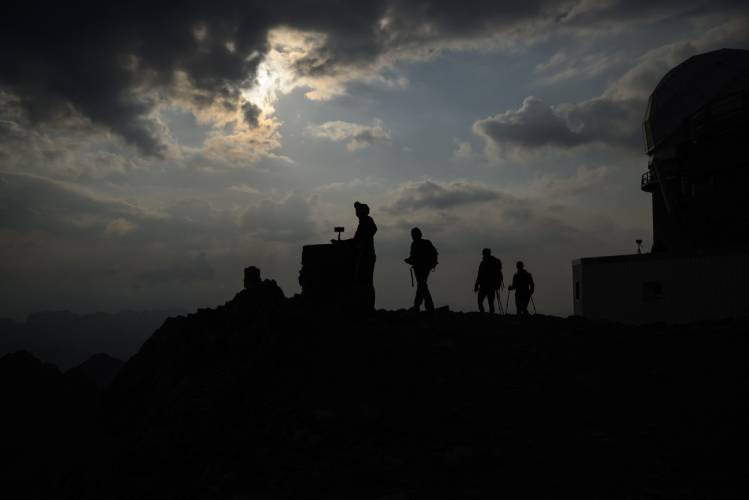
Astronomy enthusiasts prepare ahead of observing a partial solar eclipse on the summit of the Pic du Midi. [Ed Jones, AFP]
One of nature's greatest spectacles –a rare total solar eclipse –cast its shadow on Wednesday, briefly turning day into night in Russia's remote Arctic north before heading towards mainland Europe.
The Moon first blotted out the Sun at the northernmost tip of mainland Russia at about 1700 GMT, leaving only the shimmering glow of its outer corona and eerie darkness.
As the eclipse raced south towards parts of Greenland and Iceland, excitement built in Spain, where its narrow path cuts diagonally from the northwestern Atlantic coast to the Mediterranean Sea, before being expected to fade at about 1830 GMT.
Mainland Europe has not experienced a total solar eclipse for 20 years, and tourists and enthusiasts thronged normally quiet villages in Spain, which has not witnessed one in more than a century.
Iceland's capital, Reykjavik, has not seen a total solar eclipse since 1433.
"It's the first time and it's the last time, the only time I'm going to see an eclipse," Yenny Guevera, a 50-year-old Peruvian living in France, told AFP excitedly in Burgos, northwest Spain.
"I like painting, and I really like light," said Mercedes Bua, a 51-year-old engineer awaiting the eclipse's passage in a park in Colmenar Viejo, some 30 kilometres (19 miles) north of Madrid.