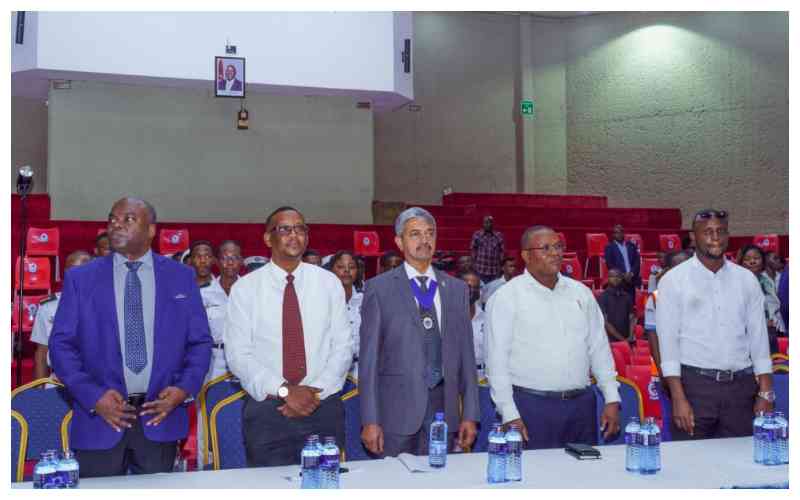
Institute of Chartered Shipbrokers International Chairman Krishnan Subramaniam (centre) with other shipping industry stakeholders at a recent public forum in Mombasa. [Jotham Mghendi-Standard]
Shipping professionals have noted that the industry has always adapted to change, but warned that the current simultaneous geopolitical, technological and environmental changes pose a new challenge.
Gathered in Mombasa last week under the umbrella of the Institute of Chartered Shipbrokers (ICS), the professionals argued that the winners will not necessarily be the largest ports, but the most adaptable ones, urging East Africa to take advantage of training, partnerships and geographical location to build resilience.
“Shipping has always adapted to change. What is different today is that geopolitical, technological and environmental changes are happening simultaneously. The winners will not necessarily be the largest ports, but the most adaptable ones,” said visiting ICS International Chairman Krishnan Subramaniam.
“Ports do not create resilience. Infrastructure alone does not create resilience. Technology alone does not create resilience. People, partnerships and professionalism create resilience. That has always been the philosophy of the ICS, and it is increasingly becoming the defining characteristic of successful maritime nations.”
Addressing several forums, Subramaniam noted that trade routes are becoming more dynamic while the Red Sea disruptions have demonstrated that shipping routes can change overnight.
He noted that diversion around the Cape of Good Hope increased voyage times and freight costs, and political tensions will continue to influence shipping patterns.
“East Africa should view this as an opportunity rather than merely a risk. Geography has become a competitive advantage again. Mombasa sits on one of the world's most strategic trade corridors,” he observed.