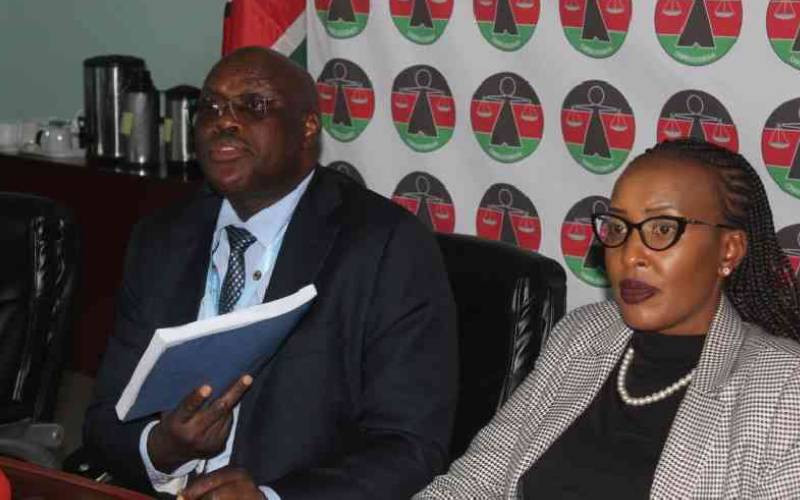
Commission on Administrative Justice Chairperson Charles Dulo and Vice Chairperson Dorothy Jemator Kimengech, during a media briefing on February 13, 2025. [File, Standard]
The Commission on Administrative Justice (the Office of the Ombudsman) occupies a unique space in public administration owing to its mandate of safeguarding the rights of citizens against abuse of power, unfairness, injustice, and failure to facilitate the right to information by public officers.
The institution is the go-to place for citizens aggrieved by a public service that is consistently failing them through delays, inefficiency, corruption and general decline in the quality of services.
On a typical day, the Commission receives and processes some grave complaints from citizens. A few cases will suffice.
Take the case of a family whose kin unfortunately passes on in a health facility and the body is detained on account of an outstanding medical bill. The family is unable to raise the money and resorts to organising a fundraising but ends up raising a paltry Kes75,000 against an outstanding bill crossing one million! They are left more traumatised and it takes the Commission’s intervention to secure release of the body.
And this is despite the courts having previously pronounced themselves on such disputes by affirming that it is against the law to detain a patient or a body on account of outstanding bills but instead use alternative means to recover the medical bills from the families.
Students pursuing studies in our education institutions expect, as a matter of course, to be issued with their results and certificates within a reasonable time. However, there are cases where this does not happen. For instance, a student graduated from a local university and had to wait for eight years for their degree certificate and transcripts to be issued only after the Ombudsman intervened. Cases of missing marks in universities are too common, as well as secondary schools declining to release students’ certificates on account of fee balances in contravention of the Ministry of Education directive prohibiting them from doing so.
In many related cases, students have complained to the Commission over errors in their certificates which the respective institutions have either ignored to correct or taken inordinately long to effect the same as required under the Access to Information Act, 2016.