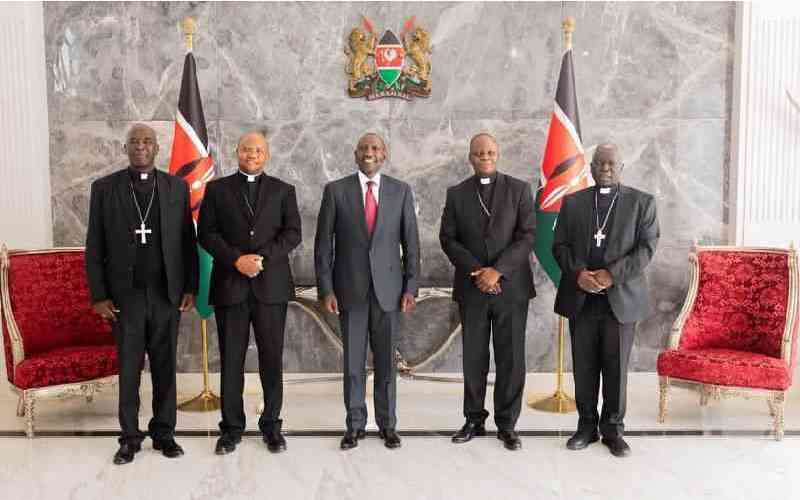
President William Ruto during a meeting with the Kenya Conference of Catholic Bishops at State House, Nairobi, on August 19, 2026. [PCS]
The relationship between religion and politics becomes especially delicate during a general election. Religious leaders command moral authority, while politicians seek public authority. Both may contribute to public debate, but blurred boundaries can reduce faith to a campaign tool and erode the independence that gives religious institutions credibility.
Jesus provides a useful starting point. When questioned about the imperial tax, he answered: “Give back to Caesar what is Caesar’s, and to God what is God’s” (Matthew 22:21). The statement does not ban believers from politics. Rather, it recognises that political authority has a legitimate but limited sphere. Caesar must not claim what belongs to God, and religious allegiance must not be surrendered to political power. Against that background, let me discuss four dimensions on this blurred boundary.
First, some religious leaders have said openly that they do not want to be deceived again by politicians who profess faith during campaigns but abandon its values after taking power. Candidates speak the language of faith, attend services, seek prayers and present themselves as defenders of religious values. Once elected, however, some govern in ways that contradict the justice, honesty, compassion and accountability they previously proclaimed.
Niccolò Machiavelli anticipated this political performance. In 'The Prince', he advised that a ruler should appear “merciful, faithful, humane, upright, and religious”. Machiavelli’s strategic approach to political communication remains an unsettling reminder that visible piety may be cultivated as an instrument of power.
Religious leaders have to guard against institutional capture. When politicians receive unrestricted access to pulpits and congregations, they may treat religious institutions as campaign infrastructure. Large donations may also create expectations of endorsement or silence. An institution dependent on political access gradually loses its freedom to criticise wrongdoing. In other words, there is no free lunch, as it were.
Second, betrayal may produce an equally dangerous reaction: The weaponisation of faith against politicians. Religious leaders who feel used may mobilise congregations against particular candidates. Politicians, meanwhile, may weaponise faith by displaying public piety, quoting scripture selectively or portraying opponents as hostile to religion. In both cases, faith is instrumentalised for political gain.