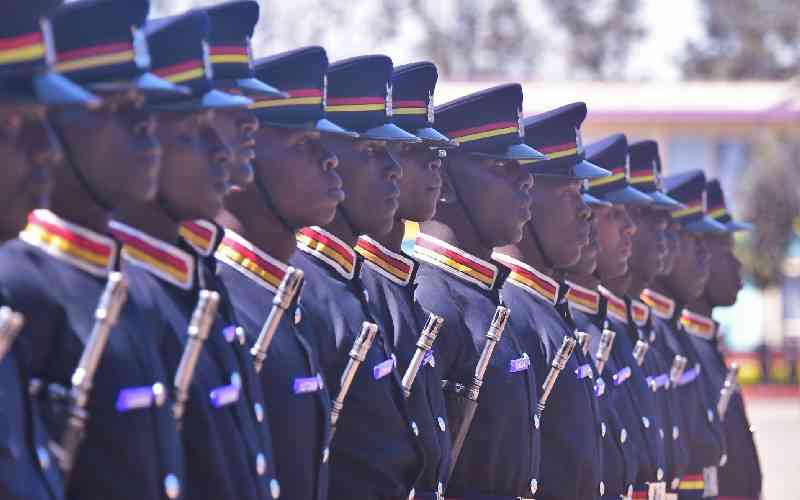
Police recruits during rehearsal ahead of Friday's passing-out parade at the Kenya Police College, Kiganjo Main campus in Nyeri County, August 25, 2026. [ Mose Sammy, Standard]
The incessant uniform spree of the police service in Kenya introduced by every regime is simply some paint on a ‘service’ that truly serves sectarian interests. As we celebrate the Constitution at 16 years, there is no state organ that has abused the Constitution either willfully or through misuse by the powers that be. It cannot be that close two decades of having the National Police Service and the National Police Service Commission and all we want to change is the uniform.
I can place the finger on the problem, it is simply a thirst for tenders, some very deliberate effort to make someone richer. But that aside, the real issue is, the Kenyan Police have never shed the skin layer of the colonial relic in its structure, that of brutality, (in)humanity, corruption and senseless killings. Despite the Independent Policing Oversight Authority (IPOA), the police remain with one of the darkest chapters in our post 2010 constitutional dispensation era.
The evidence since 2010 is difficult to ignore. From the post-election violence investigations and the killings associated with security operations, to the documented abuses in informal settlements, counter-terrorism operations and successive demonstrations, the pattern has been remarkably consistent: Excessive force, arbitrary arrests, torture, enforced disappearances and extrajudicial killings. IPOA was created precisely because the old culture of police investigating police had failed. However, oversight alone has not transformed the institution.
The 2024 Finance Bill protests exposed the problem in its starkest modern form. Young Kenyans went to the streets exercising a constitutional right to assemble and demonstrate, and too many encountered a police service that appeared to understand public dissent principally as a security threat. Lives were lost, people were injured and others disappeared or were detained. The lesson should have been unmistakable; a democratic police service cannot treat citizens exercising constitutional rights as enemies of the state.
And then came the killing of Albert Ojwang in police custody in 2025. Whatever the eventual judicial determination of individual responsibility, the episode reminded Kenyans of the oldest and most frightening question in policing, who watches the police when the person in their custody can no longer speak for himself? This is why Kenya does not need another cosmetic police reform. It needs a new skin. That skin must begin with culture. A police officer must be trained to see the citizen not as an obstacle, a suspect or a political opponent, but as the reason the institution exists. Human rights must become the operating system of policing.
The second layer is accountability. IPOA must have the resources, independence and enforcement capacity to pursue cases without institutional obstruction. Police commanders must bear responsibility for what happens under their watch. The constitutional command that policing must respect human rights, dignity and the rule of law cannot be reduced to a shell that readily responds to those that wield power. Third, Kenya needs a professional police service insulated from political command. The police must stop being available as an instrument for whoever occupies State House. Selective enforcement, political policing and the deployment of officers to settle political scores destroy public trust and corrupt the very idea of security.