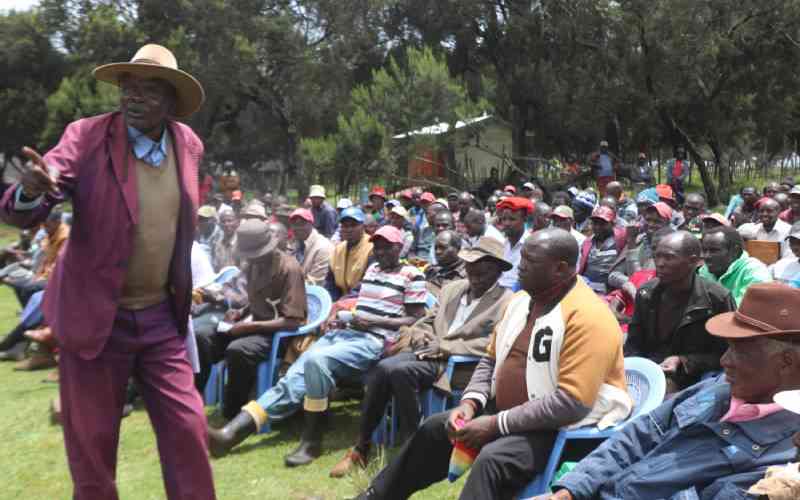
Johnson Takur, address members of the Ogiek during a consultative meeting on the ongoing registration process of the community land after court reverted the land back to the community. [File]
For the Ogiek community, the songs, dancing and colourful displays at the 7th Ogiek Cultural Festival on Friday, August 14, 2026 were meant to celebrate identity, heritage and resilience.
Instead, the gathering in Nkareta, Narok North, became a powerful indictment of a government the community accuses of ignoring court orders, perpetuating historical injustices and allowing the continued displacement of indigenous families from their ancestral land.
Held under the theme “Cultural Resilience in Diversity,” the festival brought together community elders, leaders and residents to showcase Ogiek traditions while renewing demands for the full implementation of landmark judgments recognising their rights to their ancestral territories.
Ogiek Peoples’ Development Program (OPDP) founder and executive director Daniel Kobei said the community had every reason to celebrate its culture, but little reason to celebrate its treatment by the State.
“We are here to celebrate who we are, where we came from, what we have preserved as an indigenous community and what we must continue to protect for generations to come, despite the land rights challenges facing this community,” Kobei said.
At the heart of the community's anger is the Kenyan government's alleged failure to implement landmark decisions of the African Court on Human and Peoples’ Rights (AfCHPR).
The court ruled in favour of the Ogiek in May 2017, finding violations of their rights in relation to their ancestral land in the Mau Forest. A subsequent judgment in June 2022 addressed reparations.