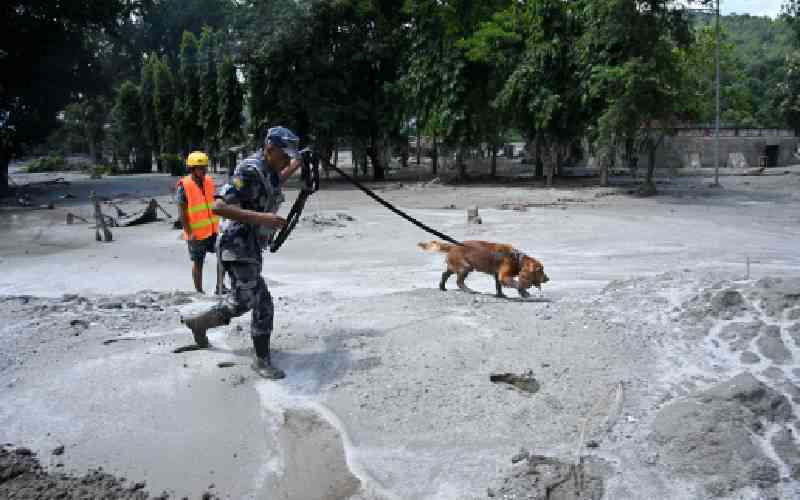
A member of the security forces and his sniffer dog search for survivors following flash floods at Trishuli in Nepal's Nuwakot district on August 27, 2026. [AFP]
Rescuers ploughed on with their search Friday for survivors of deadly floods and landslides that struck Nepal and Tibet, with the threat of new torrents complicating their gargantuan task.
Emergency teams have recovered 482 bodies after a tsunami-like wall of water and mud crashed down on Wednesday, burying homes, smashing bridges and sweeping away vehicles.
More than 1,400 people are missing, including trekkers in the Himalayas and scores of Hindu pilgrims to Tibet's sacred snow-capped Mount Kailash.
The US Geological Survey said the disaster -- the deadliest for Nepal since a 2015 earthquake -- was caused by a glacial collapse that triggered a vast flow of icy debris.
The deluge of ice and mud also caused huge pools of water to form, with one of these formations becoming a direct threat to emergency workers scouring the region for survivors.
Nepali police urged all rescuers to "immediately move to a safe location", saying it had received information that "a water dam has burst again on the Tibetan side".
Separately in Tibet, China had earlier Friday paused its rescue operation at the hardest-hit area of Gyirong over the risk of renewed flooding, before later saying the threat had eased.