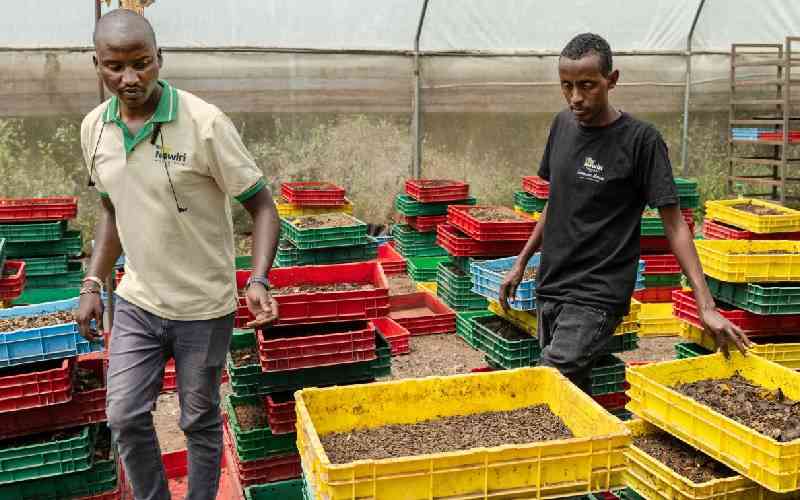
Robert Mwangi Founder of Nawiri Organics inspects the progress of mature Black soldier fly (BSF) pupae at their BSF farm in Njoro constituency, Nakuru county, on July 30, 2026. [AFP]
Kenyan farmer George Muturi says the stinky wooden shack teeming with redworms has helped rescue his land from the soil degradation caused by chemical fertilisers.
Agriculture is vital to east Africa's economy, but a 2025 soil report by the Heinrich Boll Foundation, a German think tank, found that more than 40 percent of the region's soils were degraded -- in part by overuse of chemical fertilisers -- costing more than $65 billion a year in lost productivity.
Fertiliser prices have also increased this year due to the war in the Middle East, driving a search for alternatives.
In Kenya, 32 percent of cropland was classified as strongly acidic in the soil report. Changing climatic conditions and overly intensive farming practices are among the causes, but Muturi says moving away from chemical fertilisers has boosted his harvests at his farm in Lari, about 50 kilometres (30 miles) from the capital, Nairobi.
He switched to "vermicompost" -- using redworms that turn food and crop waste into a natural, nutrient-rich form of fertiliser.
"Vermicomposting was a breakthrough for us... our soil is much better in a way that we can be able to plant and sustain the crop even during dry season," the 31-year-old farmer told AFP during a visit to his farm.