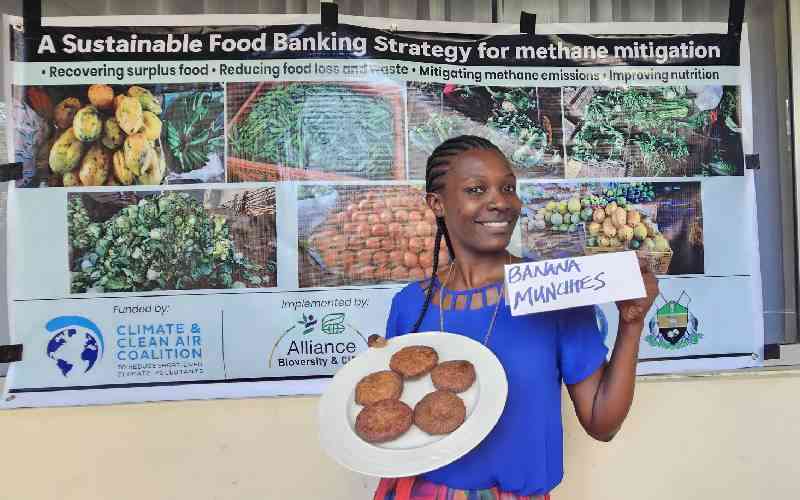
Angele Ahenda, founder of Janeko Arts, showcases banana munchkins made from overripe bananas to curb waste. [Courtesy]
Approximately 40 per cent of food produced in Kenya is wasted or lost annually.
This translates into about nine million tonnes, with a value of $578 million (Sh72 billion). At the same time, millions of households go to bed hungry owing to food shortages.
Unfortunately, once organic waste ends up in landfills and decomposes without proper management, it generates methane, a potent short-lived climate pollutant.
However, food that is wasted and ends up being a climate, environment and health hazard can be used to nourish populations, especially vulnerable groups.
Last week, a new initiative was launched in Kisumu, seeking to turn food loss and waste into an opportunity for better nutrition, climate mitigation and socio-economic empowerment.
Dubbed the Sustainable Food Banking Strategy for Methane Mitigation Project, the initiative will support the development of sustainable food banking systems in Kisumu, Vihiga and Siaya counties.