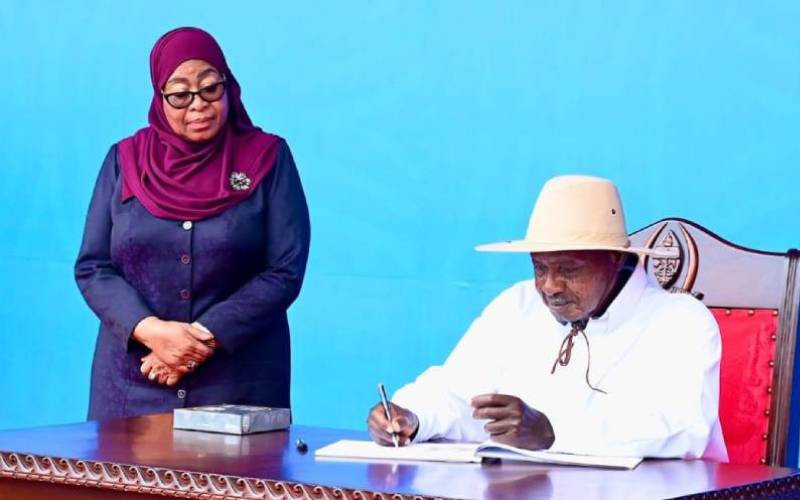
Presidents Samia Suluhu Hassan and Yoweri Museveni. [File Courtesy]
Earlier this month in Dar es Salaam, Presidents Samia Suluhu Hassan and Yoweri Museveni witnessed the signing of an agreement to develop a regional energy hub at the Port of Tanga. To understand why it matters, we need to go back to February 28.
When the US-Iran war broke out, Africa’s fuel supply was under immediate threat. Within days, major oil actors were declaring force majeure, freight and insurance costs on tanker routes spiked dramatically, and countries thousands of kilometres from the Strait of Hormuz faced the prospect of empty forecourts.
The lesson is blunt. If Africa’s energy security depends on geographies it cannot influence, its hospitals, transport networks and economies will be held hostage to conflicts and events it is not involved in.
Six months on, East Africa’s response as a region has been instructive and varied. Some countries have continued to scramble, staying fully reactive. Others have moved more decisively, taking a pragmatic approach and planning proactively for continued geopolitical instability.
The Tanga agreement, a memorandum of understanding between the Tanzania Petroleum Development Corporation (TPDC), the Uganda National Oil Company (UNOC) and Vitol Bahrain, is a glimpse of what strategic planning for the new normal looks like. The project, which builds on the nearly complete East African Crude Oil Pipeline, could eventually draw more than $20 billion in refining, storage, logistics and petrochemical investment, and potentially be one of the largest integrated energy developments anywhere in Sub-Saharan Africa.
The MoU will kick off significant technical and financial work, including feasibility studies, engineering design, and investment decisions to turn Tanga into the operating hub the understanding envisions. Even though the initiative is in its early stages, the agreement should be welcomed by citizens of Tanzania and Uganda as a strong commitment to securing fuel supply and lowering prices in the two countries.
This development is best understood by looking at their track record in recent months. Tanzania and Uganda were among the more proactive players in East Africa when the Middle East conflict erupted, and it shows in how they have navigated the resulting crisis.