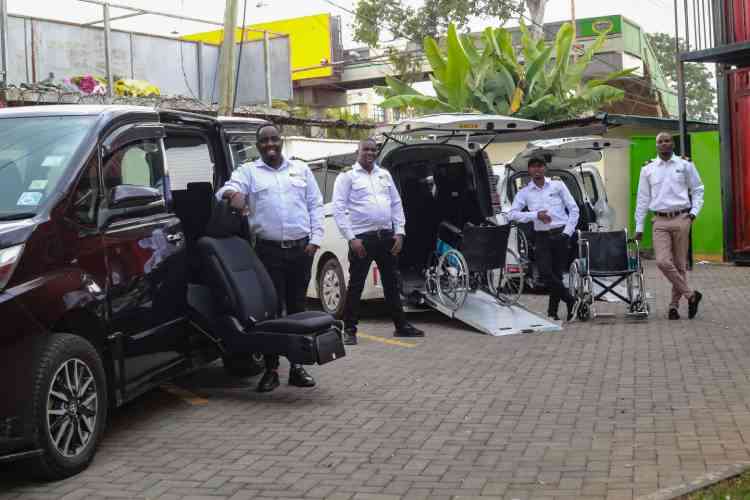
Accessible Travel Kenya team led by their founder Muthuri Kinyamu. [Mate Tongola, Standard]
As the two-day National Health Summit 2026 concluded at the Kenyatta International Convention Centre (KICC) in Nairobi, stakeholders in the transport sector called on the government to broaden its healthcare reforms to address the mobility needs of persons with disabilities (PWDs).
Muthuri Kinyamu, founder of Accessible Travel Kenya, said many people living with disabilities continue to face limited access to affordable and accessible transport, further marginalising them and restricting their independence.
Kinyamu said discussions at the summit largely focused on healthcare delivery but failed to adequately address non-emergency medical transportation, which he described as a critical component of an inclusive healthcare system.
“I have attended the summit and lots of the discussions were around healthcare. However, non-emergency medical transportation has not been factored into any of the talks,” Kinyamu said on the sidelines of the summit.
He said Kenya has a limited number of wheelchair-accessible vehicles capable of giving persons with disabilities greater independence in their daily activities.
Kinyamu, who operates a fleet of locally converted wheelchair-accessible vehicles (WAVs), said the service helps bridge the gap between emergency ambulance services and the everyday transport needs of PWDs.
“We take those with disabilities to hospitals and other places to run their errands, hence managing to cover at least the gap left by the 922 emergency hotline for ambulances and inter-facility transfers,” he said.