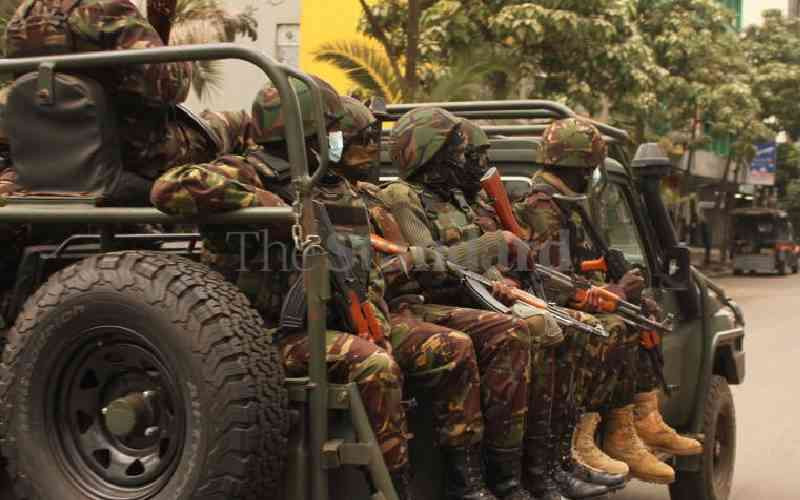
KDF officers patrol along Moi Avenue on Thursday, June 27, 2024, when protesters demonstrating for the resignation of President William Ruto engaged police in a day long running battle. [Collins Kweyu,Standard]]
There was a time when the village believed a police or military officer was manufactured differently from ordinary human beings. The uniform was supposed to come with a permanent supply of courage, a face carved from granite and, preferably, tear ducts sealed by government regulation. A policeman could arrest a thief, confront a mob and stare down danger but cry? Never. Not even on his deathbed.
Then came the recent pass-out, and social media gave the village a small cultural earthquake.
Videos of newly graduated officers embracing parents, spouses, and relatives flooded our phones. Some cried openly, tears running down faces that had supposedly been trained to remain unshaken. Mothers cried. Fathers cried. Officers cried. Even the village, after recovering from the shock, quietly wiped its own eyes.
Perhaps we have misunderstood the uniform.
Behind every stern officer is somebody’s child who once returned home muddy, somebody’s daughter whose mother worried through the night, somebody’s husband, wife, brother, or sister. The pass-out ceremony merely reminded us that before the uniform acquires authority, it belongs to a human being.
But Village Wisdom has one question: what happened to the old police or military mythology?
The village was deliberately taught that an officer should never be seen crying. Apparently, the police officer was expected to report for duty with courage in the pocket and emotions left at home with the laundry.