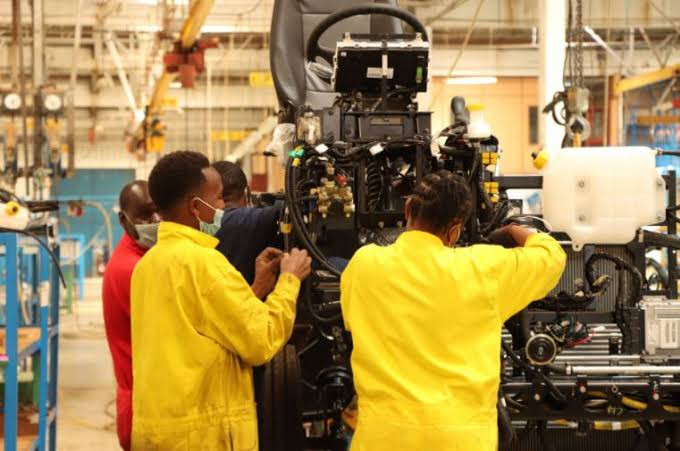
Vehicle assembling at Kenya Vehicle Manufacturers.[File-Standard]
Back in the day, the promise attached to higher education in Kenya was straightforward, as graduates would find a formal job and build a career. But with formal employment failing to keep pace with the number of young people leaving schools and colleges, that formula is increasingly being challenged.
Kenya’s national unemployment rate hovers between 5.4 per cent and 5.5 per cent, according to estimates from the International Labour Organisation (ILO).
Data from the Kenya Labour Market Information System (KLMIS) highlights that youth unemployment (ages 15–34) sits at 17.7 per cent. More alarming still, nearly 36 per cent of young Kenyans have the highest unemployment rate of 67 per cent, which means that they are trapped in low-paying, insecure, or part-time positions that do not match their skills.
The primary driver of this crisis is the formal economy's inability to create jobs. Over one million tertiary graduates and school leavers enter the market annually, vastly outpacing formal vacancies. To this end, nearly 80 per cent of Kenya’s workforce is absorbed by the informal sector, where job security and steady incomes are virtually non-existent.
This has seen many youths realigning their focus in life before graduating. Take 28-year-old James Oyori Mecha, who decided that the answer was not another job application but starting a business.
Mecha, who trained as a plumber at Morako Vocational Training Centre (VTC) in Nyamira County, graduated two months ago. Instead of joining the growing queue of young Kenyans searching for formal employment, he is preparing to register his own company and create work for himself and others.
Two months after graduating, he is already in the process of registering his own company, which he says will be key in his pursuit of a livelihood.