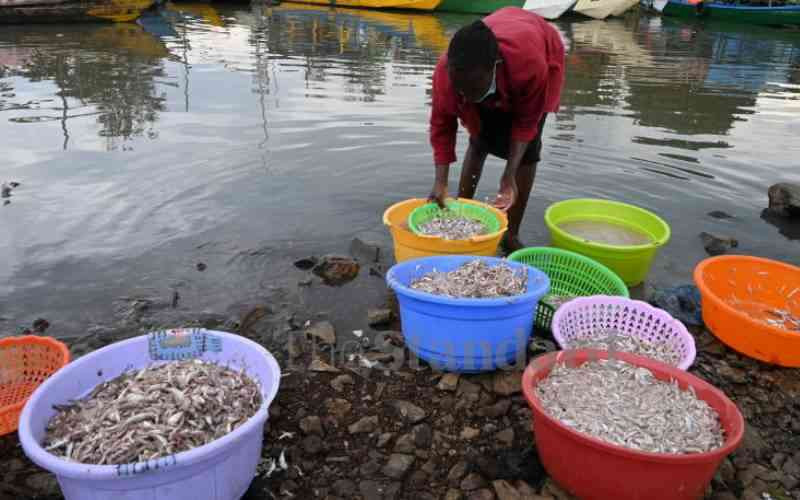
Fishmonger cleans freshly fished omena before drying at Dunga beach in Kisumu. [File, Standard]
At lakeside markets along Lake Victoria, Africa’s largest lake by area, choosing fish to eat is part of daily life. A customer might pick a tilapia based on its freshness, size, price, and farmed or non-farmed origin, much like shoppers do in markets and supermarkets around the world. Whether grilled tilapia or salmon fillet, fish are a key source of healthy fats, such as omega-3s, essential for heart health. But these nutrients are invisible. We can’t see what’s inside the fish displayed at the market.
Risks are similarly invisible; as waters grow increasingly polluted, fish become more likely to contain harmful substances such as heavy metals or pesticides. Fish are thus a “bundled” product: the same tilapia that provides essential nutrients might also carry a health risk. This creates a dilemma. Consumers face a difficult trade-off.
Vendors increasingly use labels and nutritional guidelines to help consumers “see inside the fish”, to consider both nutrient benefits and contamination risks. But even if we know the exact levels of every nutrient and toxin, how do we weigh those trade-offs? Which matters more? This complexity is difficult to communicate effectively.
One problem is that, depending on individual background and cumulative intake, the prospective gains from nutrient intake or risks from ingesting contaminants may vary.
Another challenge is that how we resolve this trade-off can change throughout our lives. At one point, our choices will be self-motivated, at another, we will have our children in mind, or pregnancy or a health condition will come into consideration. The balance between benefit and risk shifts in relation to these and other life situations.
Experience shows how difficult this balance can be. A warning issued in the United States about mercury in fish targeted at pregnant women also led many other, not-at-risk consumers to reduce their own fish intake, losing important nutritional benefits.
To better understand how the information communicated in labels affects consumer choices about these trade-offs, our international research team ran an experiment with fish consumers in communities around Lake Victoria in Kenya.