
Lead image for Fifth year puzzle: Five cases, 13 judges and different decisions in Kenya’s election date disputes.
Though the 2010 Constitution was deliberately designed to make election dates fixed and predictable, the date has generated at least five major rounds of litigation before the courts with 13 judges involved.
The litigation, spanning 2015 to 2026, has produced competing interpretations of how the constitutional election clock should be counted with different courts and judges being asked to explain what “the second Tuesday in August in every fifth year” actually means.
The 2010 Constitution deliberately anchored elections to the second Tuesday of August in every fifth year to make polling predictable.
Yet that formula has repeatedly returned to court, most recently before Malindi High Court Judge Mugure Thande, whose judgment that the election should have been held in August 2026 and not 2027 has reopened a debate earlier courts had considered settled.
According to constitutional lawyer Waikwa Wanyoike, the recurring litigation and confusion is premises on "an assumption that the Constitution guarantees every elected office-holder five years" and "entitlement of the political class".
The first legal battle involved three consolidated High Court petitions in Nairobi. Andrew Kiplimo Sang Muge, County Assembly Forum and Richard Ouma Oginda challenged the 2017 elections timetable, arguing that members of county assembly (MCAs) were entitled to five-year terms.
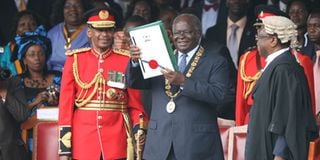
The late President Mwai Kibaki during the promulgation of the Constitution on August 27, 2010.